September 17, 2025
US citizens of color on high alert after Supreme Court allows racial profiling by ICE
This article was written by Katie Johnson for the Boston Globe on September 17, 2025
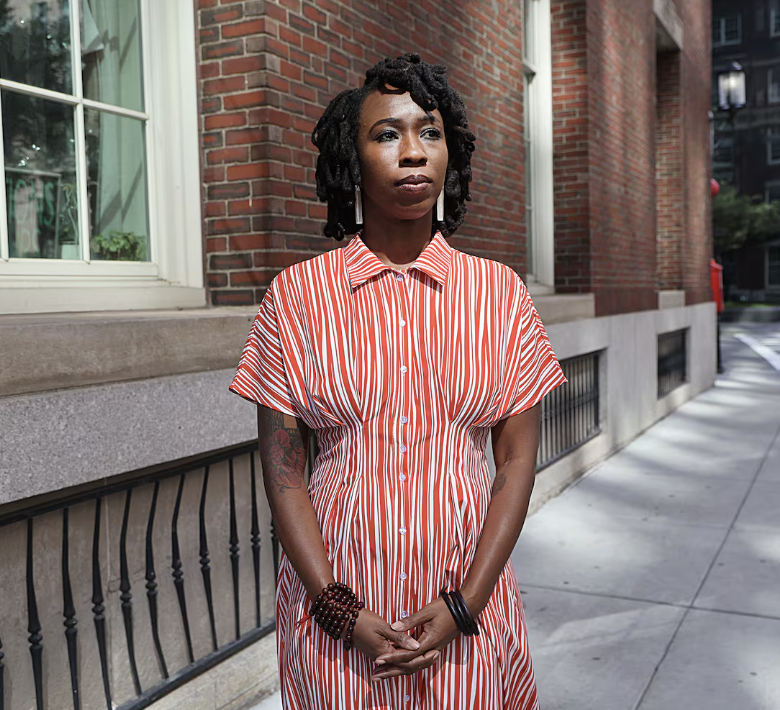
When Aba Taylor landed in Los Angeles last week, the day after the Supreme Court temporarily cleared the way for federal agents in the city to question people based on their race, she was overcome with dread and anxiety. As a Black woman, Taylor, who was born and raised in Boston, said she’sused to feeling like she has a target on her back. But this was the first time she felt directly threatened by the government of her own country.
“It was just this realization of the shift in reality,” she said.
Around the country, American citizens are growing increasingly anxious about being detained by immigration agents because of the color of their skin. Black, Latino, and Asian residents, even those who were born in the United States,are taking their passports when they leave the house and staying on high alert wherever they go. They’re checking apps that detect the presence of federal agents, deleting social media from their phones before they travel out of the country, and canceling trips to cities under scrutiny by authorities.
For many people of color, the anxiety began when Donald Trump started pledging mass deportations of undocumented immigrants during his campaign. Soon after he took office, his administration started striking down legal protections for recent arrivals and ramping up arrests and deportations, sweeping up some people here legally in the process. In recent months, he’s sent the National Guard to Los Angeles and Washington, D.C., and just announced plans to do the same in Memphis — and intensified the immigration crackdown in Boston and other cities.
Trump also did away with federal diversity and inclusion initiatives, most recently calling for the end to grants for colleges that focus on serving students from certain racial or ethnic groups.
Some say all these efforts have the same end result: taking opportunities away from people of color, whether they’re undocumented immigrants or American-born citizens.
And it is causing many to proceed with even more caution than they did before.
The Supreme Court ruling in particular raised concernsin communities of color because it clears the way for immigration officers to use racial profiling to detain people, according to the American Immigration Council, making it more likely that raids could sweep up US citizens and people here legally. Though the ruling is specific to LA, it has sparked concern that federal agents elsewhere will also be emboldened to stop people they suspect are immigrants.
A lower court had ruled that Immigration and Customs Enforcement agents were violating the Fourth Amendment by stopping peoplein Los Angeles without reason, but,while litigation continues, the Supreme Court decision allows agents to question residents based solelyon four factors: their race or ethnicity; speaking Spanish or English with an accent; the type of work they do; or their location,such as a pickup site for day laborers.
Carlos Barbosa, a general contractor and developer in Hyannis, left Brazil for the US 38 years ago and has been a US citizen since 2003. He now carries his passport wherever he goes, worrying that authorities will “take me to jail and then ask questions later” if he can’t immediately prove he’s a citizen.
Still, Barbosa is more angry than scared.
“I came here because it’s the perfect country to have a life; here democracy and justice prevail always,” he said. “But it’s not the case anymore.”
For Eric Nguyen, a Vietnamese American who was born in Boston and grew up in Lowell, the ripple effects of the Supreme Court ruling are particularly troubling — “the ways in which it empowers people to act in ways that expose their racist, xenophobic tendencies,” he said.
The recent raid at a Georgia battery plant co-owned by the carmaker Hyundai, where hundreds of workers from South Korea were detained and sent to Seoul, including at least one in the US legally, was a reminder that Asian and Asian American communities can’t get too comfortable, said Nguyen, the senior director of consulting and training at YW Boston.
“Nobody’s free until we’re all free,” he said, paraphrasing the words of civil rights leader Fannie Lou Hamer.
“The fact that there’s a suggestion that the Supreme Court … might think that it’s OK to target people and to racially profile is a real break from the history of constitutional protections in this country,” said Carol Rose, executive director of the ACLU of Massachusetts. “It could definitely alter the overall feeling of safety for people of color.”
The White House said the Supreme Court ruling simply applies the precedent of what constitutes “reasonable suspicion” under the Fourth Amendment.
“What makes someone a target of ICE is if they are in the country illegally — and implying otherwise is not only insulting to brave law enforcement officers who do their jobs with the utmost professionalism, but it fuels a dangerous narrative and fuels the 1000 percent increase in assaults against ICE officers,” spokesperson Abigail Jackson said in a statement.
Tricia McLaughlin, assistant secretary for public affairs at the Department of Homeland Security, called the Globe’s questions about the fears of American citizens of color “false smears” that “are contributing to political violence across the country.”
But the fear is real. Six women of color who were part of a leadership program decided not to go to the closing session in LA last week because they were worried about the increased presence of immigration agents, Taylor said.
Taylor is the president of YW Boston, a nonprofit focused on equity, a position she took on shortly after Trump announced his anti-DEI efforts. And her security at public speaking engagements has been a concern ever since. She brings her passport card with her everywhere and travels with copies of her and her daughter’s birth certificates. Even when she went to Newport over Labor Day weekend, she said, she made sure that people knew where she was and that her phone was charged.
Now, with the recent high court ruling, race has made people a potential target of immigration agents, regardless of their citizenship.
“It’s the same Supreme Court that said affirmative action is illegal,” Taylor said. “You can’t take race and ethnicity into consideration for college admissions, but you can now for pulling people off the street.”
Another Black nonprofit director in Boston, who asked not to be identified to protect the people he works with, carries three forms of ID at all times, including his Global Entry card, despite the fact that he was born in the US.
“It’s a really dangerous time,” he said. “I don’t think people can comprehend what it feels like to be a person of color in this moment.”
Ron Bell, a civic engagement organizer in Boston who founded the voting rights organization Dunk the Vote, started passing out a booklet called “The Black Book” earlier this year to inform people of their rights pertaining to immigration and racial profiling. It’s work he’s been doing for decades, after being racially profiled during the Charles Stuart case, when Boston police used stop and frisk tactics in Black neighborhoods.
“This is not new to Black people,” Bell said of people being detained without cause. “Black men are saying to me, ‘Oh, it’s a matter of time.’ They’re expecting it to happen.”
A Latino executive and community leader in the Boston area, who asked not to be identified because of concerns about his personal and professional security, said his world has been turned upside down by the immigration crackdown.
His cousin who was seeking asylum here was thrown in jail. The nannies who used to watch his children are afraid to leave their homes. Several of his children’s classmates have stopped attending their dual-language school. His family’s Sundays haven’t been the same since an ICE vehicle was spotted outside their church.
When his family left the country in June, he and his wife deleted WhatsApp and other social media apps from their phones in case they were seized. After the Supreme Court ruling, he made digital copies of their passports.
“You just never know,” he said.
Anh Nguyen, 21, worries that speaking Vietnamese with his mother in public could be dangerous. When he was growing up in Dorchester, the threat of violence, including school shootings, was always present, Nguyen said.
But he was never worried about being locked upby the government. Until now.